|
Inspiration4Learning |
The Spread of a Virus
Here we describe a few ideas for discussing COVID-19 in math class. We’ll limit ourselves to a few simple games to introduce basic concepts.
Teaching with an applet about the spread of a virus
The NCTM—an American association of math teachers—has a great applet that visualizes the speed at which a virus spreads. The applet is in English, but it can help you discuss the spread of a virus with your students in class. Take a look at the NCTM Applet on the Spread of a Virus. There you’ll find not only the applet, but also an explanation of how it works, an explanation of the math involved, and a series of activities for different age groups.
Some games for the classroom
An applet like this won’t always be clear. You don’t get a firsthand sense of exactly how the spread works. Various games can be more helpful in exploring the meaning of the R value (which indicates how many people, on average, one infected person has infected after a few days). With such games, students can also explore exactly what the effect of “social distancing” is. It’s not just the R value that’s important. Now there’s also an emphasis on the K value. Nemo explains exactly what the K value is.
The games described here help students see how we are gradually building a better model for the spread of a virus.
Tag
Almost every child has played tag at some point. In fact, tag is a special case of virus spread. You pass the turn (the virus) to one other person, and you’re free of it (cured). In this model, however, you can be tagged again (re-infected). With a real virus, we hope that most people won’t get reinfected. This game just keeps going. You can introduce a variation: once you’ve tagged someone, you get to sit out for a while. Gradually, the group of children playing (who are not yet infected) gets smaller and smaller. With this variation on tag, you can discuss with the children, among other things, how many rounds are needed until everyone has had a turn.
Tag is a game with an R value of 1: one infected person infects one other person. It is not particularly suitable as a model for the spread of a virus. The students will certainly be able to describe why this does not resemble the spread of a virus. Someone who is sick makes more people sick, you don’t recover as quickly, sometimes you get sick again, people can live in smaller groups,... Other games help develop a better model.
The Sit-Stand Game
New rules
By changing the rules of the game, we can examine different R values. This is already done with the sit-stand game. The rules of this game are:
- When we start, everyone is seated
- You ask a student to stand up
- That student then asks two other students to stand up
- Those students each ask two other students to stand up
- Etc.
Suddenly, it goes a lot faster. After you’ve played this once or a few times, you can ask a few questions, for example:
- After how many rounds is everyone standing?
- Why is that so much faster than playing tag?
- How many rounds will it take to infect the whole school (i.e., get everyone to stand up)?
- After how many rounds will the entire city/town be infected?
- What changes if we don’t pick 2 people, but always pick 3 people?
Have the class play this variation a few times.
Representing the spread on the board
You might consider drawing one of the rounds on the board together with the students. This tree gives an idea of what such a representation might look like.
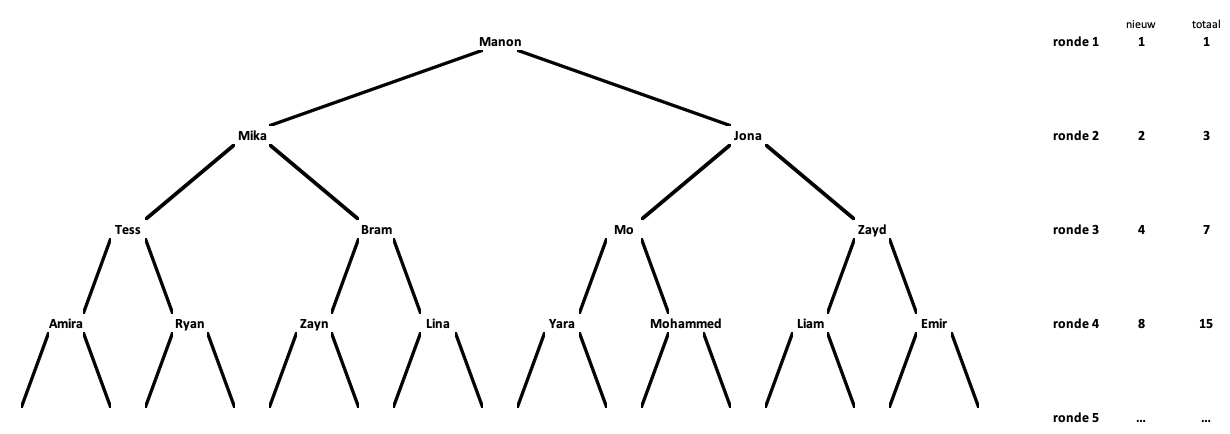
An R value of 2 and exponential growth
The R-value of this game is 2. An infected person always infects two other people. The growth is exponential. With this game, students can see how quickly that happens. The entire school or the entire city becomes infected much faster than most students expect. It is important for them to realize just how overwhelming exponential growth is.
Students can discuss in small groups how many new people are infected in rounds 5, 6, 7... and how many total infected people there are after each new round. Do you see the pattern in the numbers of new infections (powers of 2) and the total number of infected people (powers of 2 minus 1)? It’s a good idea to then have the students work in small groups to think about what a tree would look like if they added 3 people each time.
The game with two-colored tokens
You can also have students play this game and the following games in small groups. The students will need a large number of two-colored tokens. Explain that the tokens are blue on one side and yellow on the other. The rule of the game is that they start with all the yellow sides facing up. Next, they flip one token over, and with each round they flip two more tokens over, and so on. At first, this is confusing for students, so it’s probably wise to first play with the whole class as a sit-stand game and only then in groups with the tokens.
The Go-Stand Game with Risk
In reality, not every contact leads to the spread of a virus. We can incorporate this into the game. To do so, we change the rules slightly. We make the number of people you can infect depend on the roll of a coin or die.
By flipping a coin
The rule is now: "You don’t always point to two other students; first, you flip a coin. If it’s heads, you point to one other student to stand up. If it’s tails, you point to two other students to stand up, etc."
First, have the students discuss in small groups what they think will happen next. As you walk around and listen to the groups, you might consider the following questions:
- After how many rounds do you think everyone in the class will be standing?
- Is this faster than playing tag? Why or why not?
- Is it faster than the “stand up” game? Why or why not?
Have the class play this variation a few times. You might consider drawing a tree during one of the rounds.
We can also calculate the R-value during the game. This relates to the probability of infecting someone. In half of the cases, you infect 1 person; in the other half, you infect 2 people.
With a die
This time, a student rolls a die. If the number on the die is 1, 2, or 3, the student infects no one. If the number is 4 or 5, the student infects one other student. If the number is 6, the student infects 3 students.
Have the students play the game a few times. What stands out is that this time the infection keeps dying out. Sometimes very quickly—it’s over with a single roll. Sometimes it takes a little longer, but the entire class will likely never become infected. Wait until the students start to notice this. That’s a good moment to ask them what the difference is between the last three games.
In these games, we simulate different R values. With some knowledge of probability, this R value can be calculated.
| Keep an eye on the die | 1 | 2 | 3 | 4 | 5 | 6 |
| Number of people infected | 0 | 0 | 0 | 1 | 1 | 3 |
If the number of infections is determined according to this table, then the R value is 0×⅙ + 0×⅙ + 0×⅙ + 1×⅙ + 1×⅙ + 3×⅙, or ⅚. This means that in most simulations, the number of infections will die out. In class, you will see that in some groups the infections die out quickly, while in other groups it may take a little longer.
Next, discuss with the students which values you can change to ensure that the number of infections keeps increasing. For example, to create an R-value of 1⅓, we can change the table to:
| Eyes on the die | 1 | 2 | 3 | 4 | 5 | 6 |
| Number of people infected | 0 | 0 | 0 | 1 | 1 | 6 |
After all, the R value is now 0×⅙ + 0×⅙ + 0×⅙ + 1×⅙ + 1×⅙ + 6×⅙. When children use this table to play the simulation, the infection will die out in some groups while it will spread rapidly in others.
The sit-stand game with social distancing
The idea behind social distancing is that we have fewer contacts and therefore—if we are infected—we will infect fewer people. That is why some sports organize small bubbles where it is agreed that people will only have contact with those in the bubble. We are going to reenact this in class. We are changing the rules of the game once more. When it is your turn to pick someone else, you first flip a coin. If it’s heads, you pick one other student in your group to stand up. If it’s tails, you pick two other students in your group to stand up, and so on.
First, have the students discuss in small groups what they think will happen next. As you walk around and listen to the groups, you might consider the following questions:
- After how many rounds do you think everyone in the class will be standing?
- Is this faster than playing tag? Why or why not?
- If we keep playing for a long time, will there come a moment when everyone in the class is standing? Why or why not?
Have the class play this variation a few times.
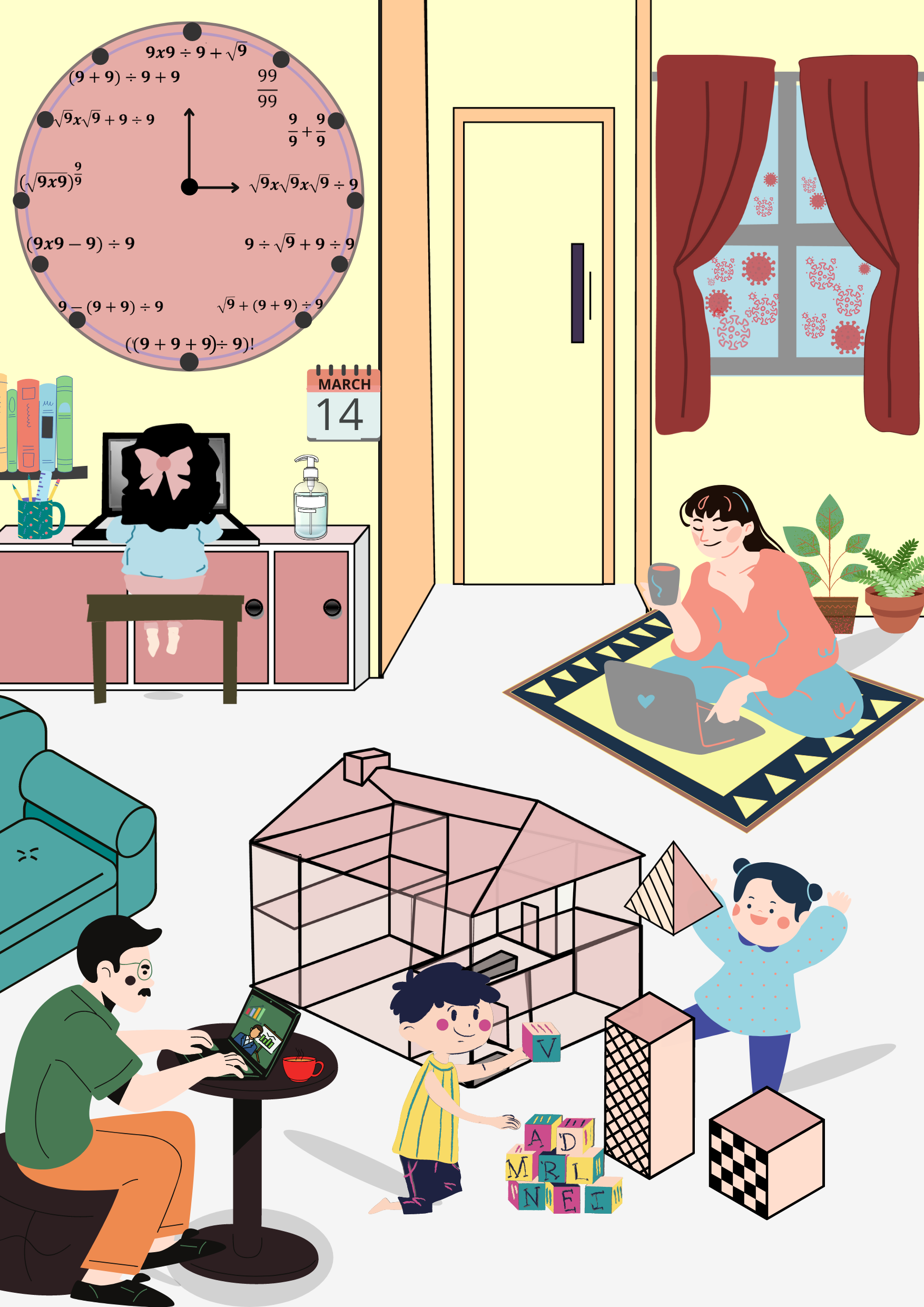
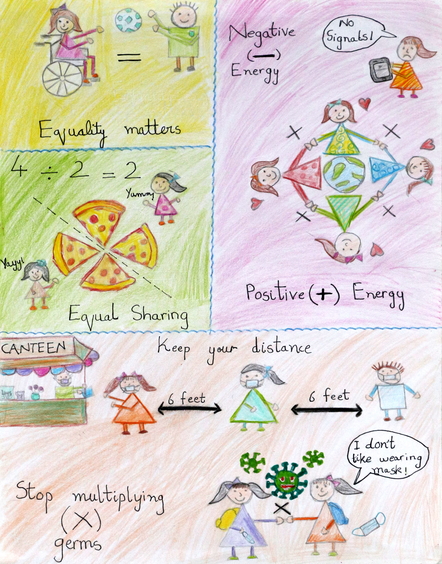
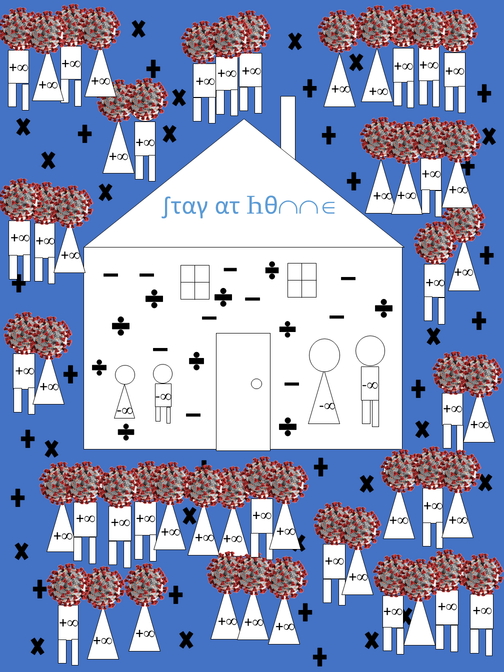
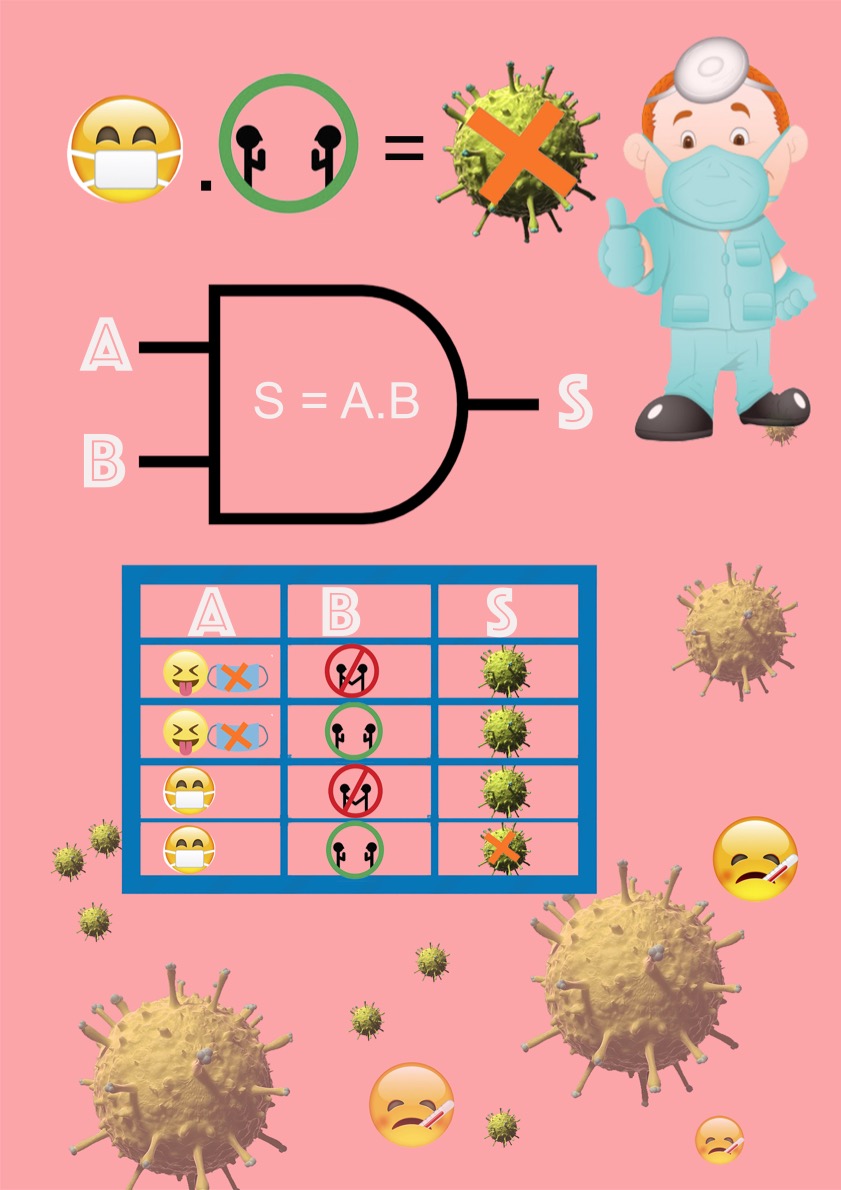
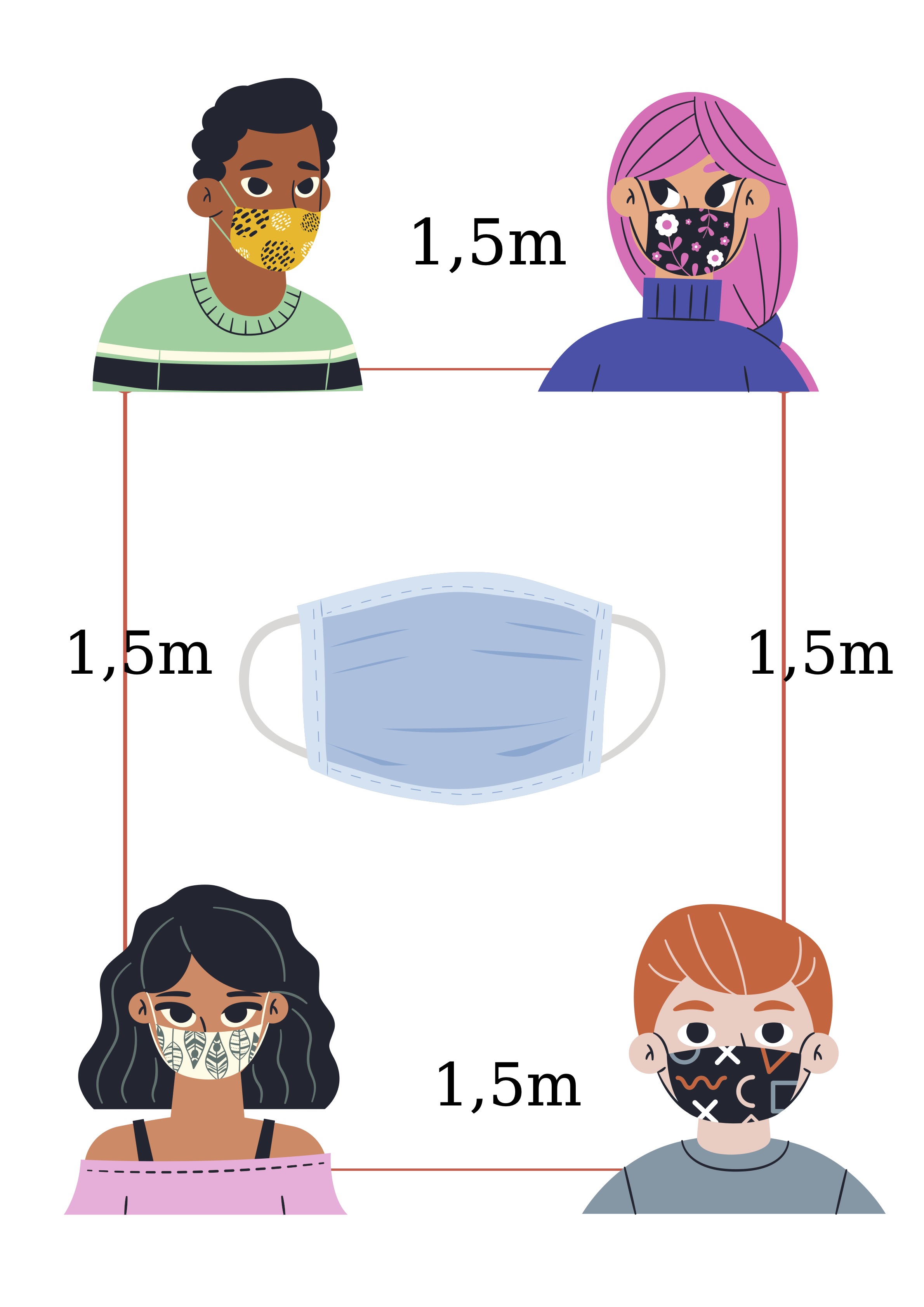
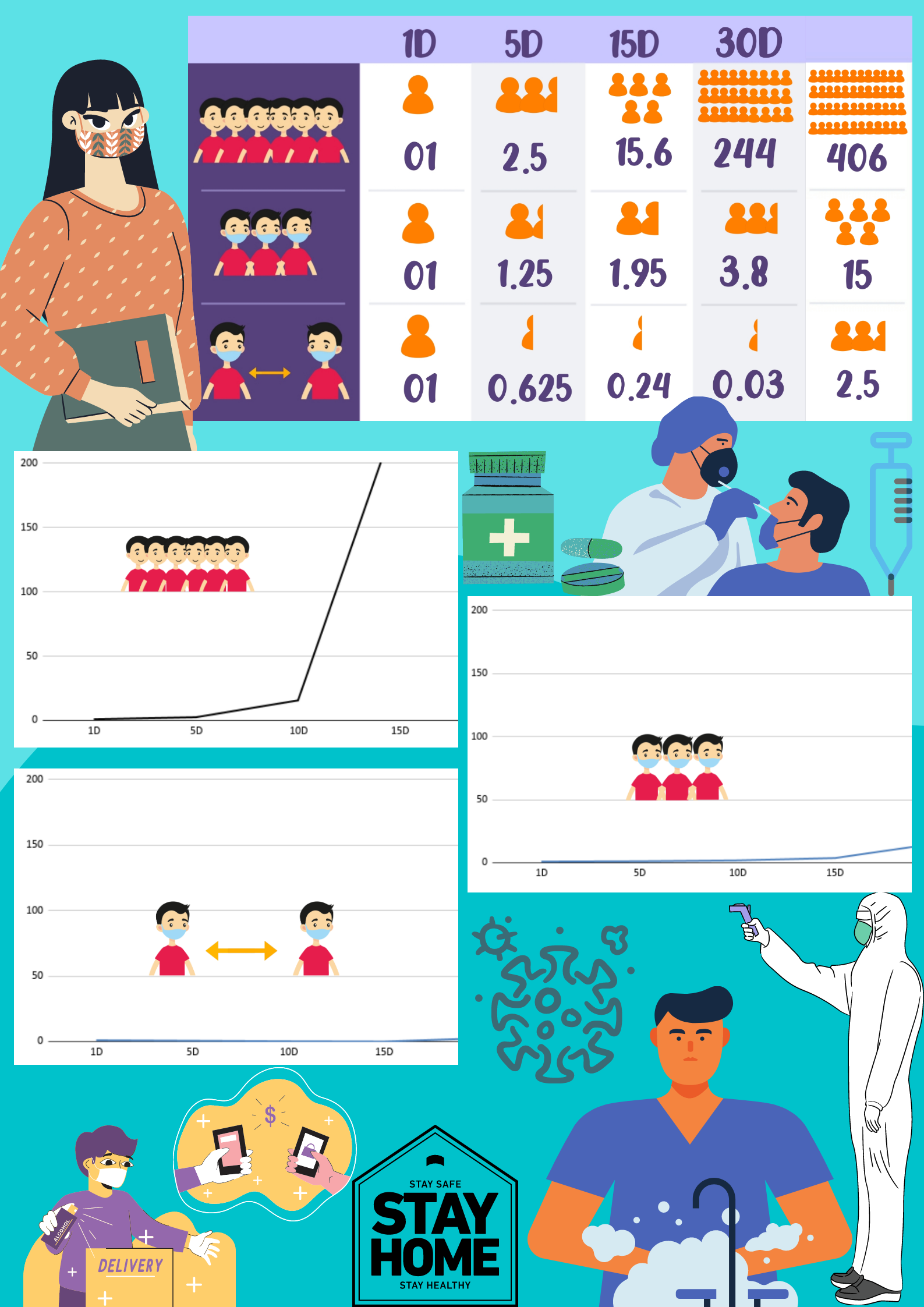
Posters about Covid created by students
The IDM 2021 also produced some great posters about Covid and math. On their website, you can view other posters and read about who created them and what they were thinking when they made them.
| ©2026 Inspiration4Learning — All rights reserved |
